
LINUX + ANDROID
Endpoint security for Linux and Android.
BastionGuard delivers transparent, privacy-first protection across Linux desktops and Android devices — with real-time threat detection, explicit security controls, and clear decisions you can trust.
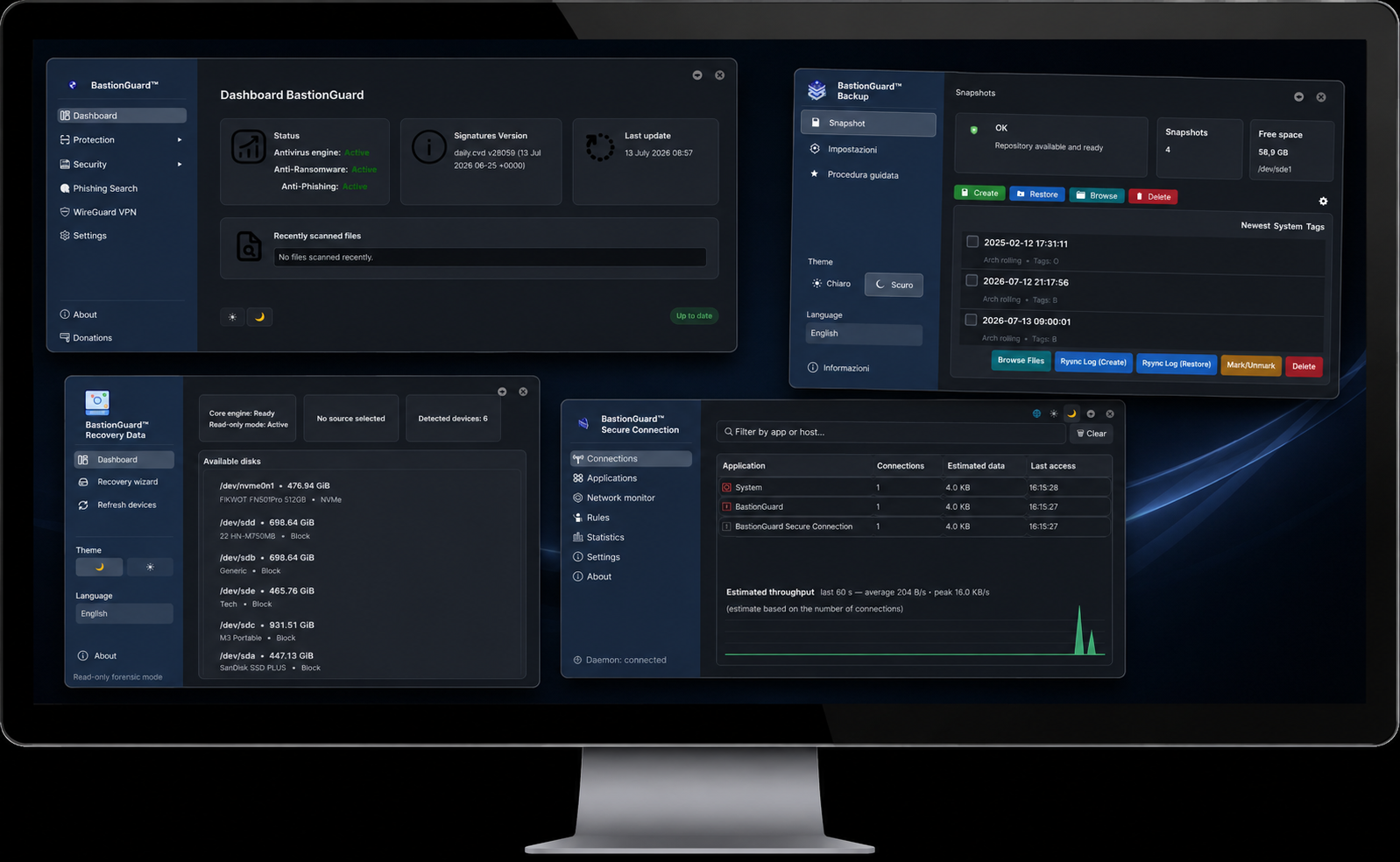
BastionGuard provides multilingual support, including Arabic, German, Spanish, French, Italian, Japanese, Dutch, Polish, Portuguese, and Russian.


BastionGuard suite
BastionGuard is an integrated Linux security suite that includes BastionGuard Endpoint, BastionGuard Backup, BastionGuard Secure Connection, and BastionGuard Recovery Data.
Why BastionGuard
Security you can see, control, and reason about.
BastionGuard is not a “trust us” security product.
It is a security control plane built for Linux desktops, where every protection mechanism is explicit, deterministic, and observable.
Most desktop security tools hide decisions behind opaque engines, cloud scoring, or silent automation. BastionGuard does the opposite.
Real-time Scanning
On-access scanning integrated with the filesystem, fully configurable and auditable. Includes i-notify and monitors each directory.
Anti-Ransomware
Detects ransomware behavior using YARA rules and controlled scanning, with user-visible rules and allowlists.
Anti-Phishing
Blocks malicious domains and redirects using deterministic lists, DNS control, and firewall enforcement — no silent cloud decisions
USB Scanning
Removable devices are scanned on insertion, with explicit user feedback and no automatic execution.
Secure Payments
Enforces a sandboxed browser for payment and checkout domains, based on a user-managed allowlist.
Webcam & Microphone Privacy
Controls access to camera and microphone resources, preventing silent or unexpected usage.
Identity Leak Monitoring
Monitors exposed credentials using public breach intelligence, with clear severity and source attribution.
Samba / Network Share Scanning
Scans files accessed through Samba and network shares, enforcing the same security policies applied to local files.
Security Updates
Keeps all security engines and threat intelligence up to date with verified signature, rule, and database updates.
BastionGuard VPN
Secure WireGuard connections with key generation, configuration import, public IP verification, DNS management, and an nftables-based kill switch.
BastionGuard Password Manager
A local encrypted vault with AES-256-GCM protection, password generation, fast search, browser CSV import, and secure credential management.
BastionGuard Backup
System snapshots and recovery with RSYNC or BTRFS, scheduled backups, retention policies, encrypted-volume support, and bootable recovery tools.
RootGuard
RootGuard is BastionGuard's eBPF LSM privilege-escalation and filesystem metadata monitor. It filters global metadata activity down to privilege-relevant transitions and performs complete baseline monitoring on explicitly protected system identities, where changes can be denied before they are committed.
SECURITY
Security as a control plane, not a black box
Security you can see, control, and reason about.
BastionGuard is not a “trust us” security product.It is a security control plane for Linux desktops, where protection is explicit, deterministic, and observable.No opaque engines. No silent automation. No hidden cloud decisions.
Deterministic by design
Deterministic by designEvery action in BastionGuard follows explicit rules and policies: No silent blocking No hidden heuristics No undisclosed cloud decisionsIf something is blocked, scanned, redirected, or sandboxed, you know why — and you can inspect, change, or disable that behavior.Designed around Linux primitives: systemd, filesystem policies, local services, and explicit privilege boundaries.
Local-first, not cloud-dependent
BastionGuard operates primarily on the local system: Local signature databases Local YARA rules Local DNS control Local policy enforcement Cloud services are optional and clearly scoped (for example, identity breach monitoring or optional Safe Browsing checks). Core protections remain functional even offline.
Explicit policy boundaries
BastionGuard enforces clear security boundaries, instead of blending everything into a single opaque engine: Filesystem access is scanned explicitly USB devices are scanned on insertion Network shares (Samba) are treated as untrusted sources Payment domains are allowed only through an explicit allowlist Secure browsing runs in a sandboxed environment Webcam and microphone access are controlled, not assumed safe There are no implicit trust zones.
Privilege separation and transparency
BastionGuard respects Linux security principles: User-level services use systemd –user System-level changes require explicit privilege escalation Configuration files are readable, inspectable, and versionable Updates are visible and auditable Nothing happens “behind your back”.
Built for Linux users, not adapted from elsewhere
BastionGuard is designed for Linux, not ported from another ecosystem: GTK-based native UI systemd-native service management Filesystem-aware scanning Network and DNS control aligned with Linux workflows It integrates with the system instead of fighting it.
SUPER FAST
BastionGuard is fully open source.
Every component — from real-time scanning to ransomware detection, phishing enforcement, sandboxed browsing, and system services — is implemented as auditable code, not opaque binaries.
There are no hidden cloud decisions, no silent automation, and no proprietary black boxes.
What BastionGuard does is visible, traceable, and verifiable.

BASTIONGUARD – SECURITY – ENDPOINT
If you want security you can understand
not just install —
BastionGuard is built for you.
Explore the source code, documentation, and architecture.
Security should be something you can reason about.
Testimonials
Trusted by security-focused users
Use testimonials to show feedback, quotes and community trust signals.